

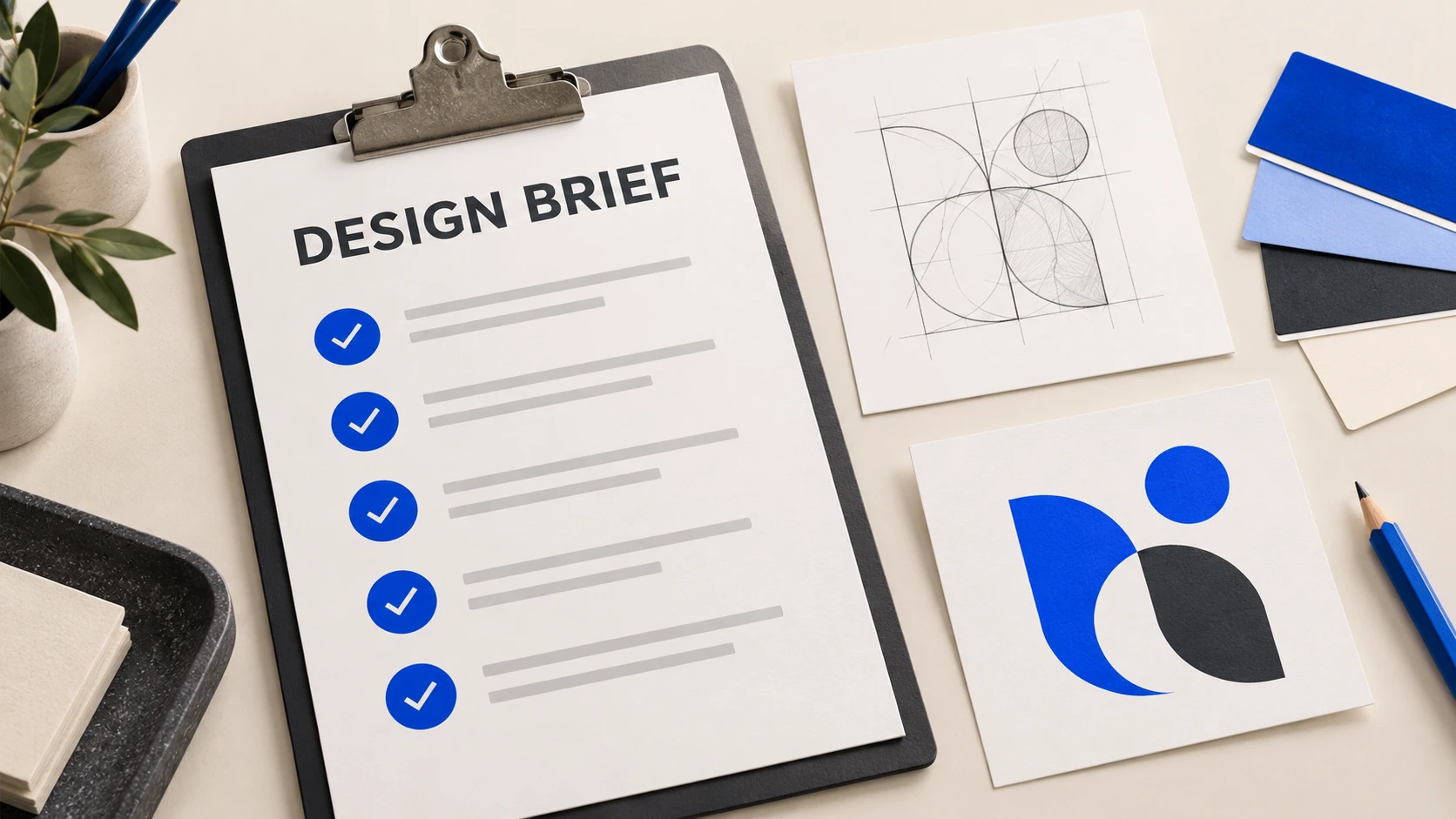
Short answer: a logo design brief is a short document that tells a designer who you are, who your customers are, and what you want the logo to communicate. A good one covers eight things: your business, your audience, your competitors, your brand personality, style preferences, colours, where the logo will be used, and practical details such as the exact name and tagline.
Designers cannot read minds. When a logo project goes round in circles, the cause is almost always the same: the designer was given too little to work with. Fifteen minutes spent on a clear brief saves days of revisions — and it does not require any design knowledge at all.
What Is a Logo Design Brief?
It is a written summary of your business and your expectations, given to the designer before work begins. Think of it as directions rather than a drawing: you describe the destination, and the designer works out the best route.
Why Does the Brief Matter So Much?
- Better first concepts. The designer starts closer to what you want.
- Fewer revision rounds. Less guessing means less correcting.
- Faster delivery. See our guide on how long logo design takes for how much time feedback rounds add.
- A logo that fits the business, not just one that looks nice.
What to Include in a Logo Design Brief
1. About your business
What you sell, where, and for how long. Two or three plain sentences are enough. Include what makes you different from the business down the road.
2. Your target audience
Who buys from you? Age range, location, budget, and what they care about. A logo for retirees booking river cruises should not look like one for teenagers buying trainers.
3. Your competitors
List two or three. The aim is not to copy them but to make sure you look different. If every competitor uses blue, that is useful to know.
4. Brand personality
Pick three to five adjectives: friendly, premium, bold, traditional, playful, minimal, technical. Adding what you are not helps too — "professional but not corporate".
5. Style preferences
Share a few logos you like and, just as usefully, a few you dislike, with a sentence on why. If you know which type of logo you want — a wordmark, an emblem, a symbol with text — say so.
6. Colours
Mention any colours you already use, any you want to avoid, and whether you are open to suggestions. If you are starting from scratch, our guide to colour psychology in logo design will help you think it through.
7. Where the logo will be used
Website, signage, vehicles, packaging, uniforms, app icon? This changes design decisions. A logo that will be embroidered on a shirt needs to be simpler than one that only lives on a website.
8. The practical details
The exact wording and spelling of your business name, including capitalisation. Your tagline, if it should appear. Anything that must be included or avoided.
Free Logo Design Brief Template
Copy the questions below and answer each in a sentence or two.
- Business name (exactly as it should appear):
- Tagline (optional):
- What we do (in one or two sentences):
- Our customers are:
- Our main competitors are:
- What makes us different:
- Three to five words that describe our brand:
- Logos we like, and why:
- Logos we dislike, and why:
- Preferred logo type (wordmark, symbol plus name, emblem, no preference):
- Colours to use or avoid:
- Where the logo will mainly be used:
- Anything that must be included or avoided:
An Example of a Good Brief
Here is a short, made-up example to show the level of detail that works:
"Harbour Lane Bakery is a family-run bakery opening in a coastal town. We sell sourdough, pastries and coffee to locals and weekend visitors, mostly aged 30 to 60. The two other bakeries nearby look traditional and use brown and gold. We want to feel warm, modern and handmade — not rustic or old-fashioned. We like simple logos with a small symbol and clean lettering. Open to colour suggestions, but no brown. The logo will go on our shopfront sign, paper bags, coffee cups and Instagram."
That is under a hundred words, and a designer could start work on it immediately.
Common Mistakes to Avoid
- "I'll know it when I see it." This guarantees extra rounds. Even rough preferences help.
- Designing it yourself in the brief. Describing an exact drawing leaves the designer no room to solve the problem. Explain the goal instead.
- Contradictions. "Minimal" and "include our six services" cannot both be true.
- Too many decision-makers. Agree internally first, then send one brief.
- Chasing trends. Fashionable effects date quickly. Our take on 2026 logo trends separates what lasts from what does not.
Frequently Asked Questions
How long should a logo design brief be?
One page is plenty. Clear and short beats long and vague.
What if I do not know what I want?
Start with what you do not want, and describe your customers well. A good designer can work from that.
Should I include a sketch?
You can, as long as you present it as a starting idea rather than an instruction.
Do I need a brief if I use an online logo design service?
Yes — it is usually built into the order process. With us, you fill in your design details in the Design Lounge after ordering, and the designers begin from there. See how our process works.
Got your brief ready?
Send it to our designers and receive original logo concepts, usually within 2–3 business days. Packages from $29 with unlimited revisions and a 100% Money Back Guarantee.
See Packages